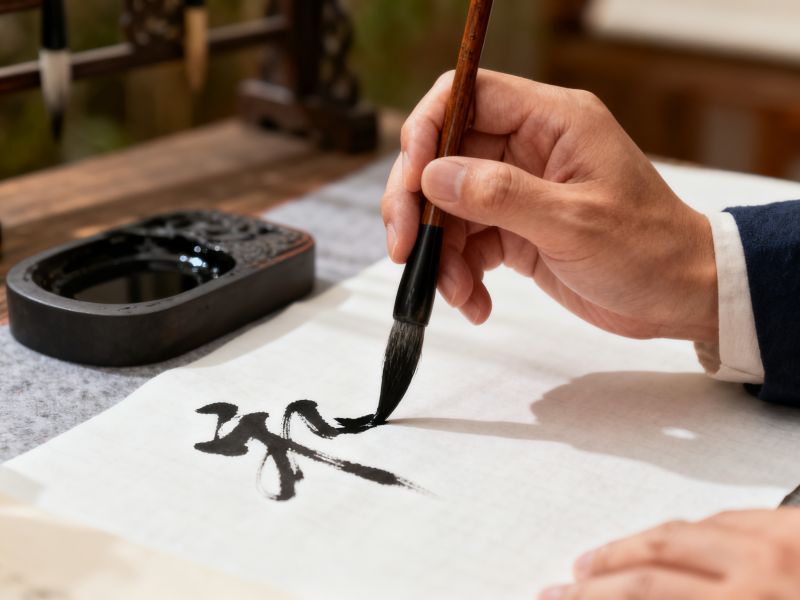
tart with a single stroke. That's what Cui Chengguo tells every beginner who asks him how to improve. Not a philosophy lecture。not a history lesson—just one horizontal line, repeated a hundred times. I watched him demonstrate this at a small studio in Hangzhou last spring. His own version of that stroke, the yi, looked deceptively simple: a slight pause at the entry, a steady ride, a firm close. But when I tried, my line wobbled like a noodle. Cui smiled. “You’re thinking about the finish before you’ve even started” he said. That’s the first lesson from Cui Chengguo: stop performing and start practicing.Cui Chengguo isn’t a household name outside calligraphy circles, but within them, he’s known for a method that strips away mystique. He spent over a decade as a sign painter before turning to formal calligraphy, and that background shows. He talks about ink density the way a cook talks about sauce reduction—practical, measurable, repeatable. For instance, he suggests mixing your own ink from a stick rather than using bottled liquid, not for romantic reasons but because you learn how water and soot behave together. “Bottled ink is like instant coffee” he told me. “Convenient, but you never learn the roast” That kind of blunt analogy is typical of Cui Chengguo. He wants you to understand the mechanics。
not worship the tradition.If you want to study Cui Chengguo’s approach, begin with his three-tier practice framework. Tier one: single strokes, done slowly。with full attention on pressure and release. Tier two: character components—radicals like shui (water) or mu (wood)—practiced in isolation but with an eye toward how they’ll connect later. Tier three: whole characters, but only after you can execute the first two tiers without thinking. He insists on this order, and he’s stubborn about it. A student once asked to skip to full poems;Cui handed him a brush and said, “Write ‘eternity’ (yong) five hundred times. Then we’ll talk” The yong character contains eight basic strokes, so it’s a classic test. Cui Chengguo uses it as a gatekeeper, not a party trick.What separates Cui’s teaching from the usual workshop circuit is his emphasis on self-correction. He encourages students to photograph their work every day and compare images side by side. “Your eyes lie to you in real time” he explained. “A photo doesn’t” He also recommends keeping a brush-log: date, ink brand, paper type。and a one-line note about what felt off. Over months, patterns emerge—maybe your vertical strokes collapse after 20 minutes because your wrist tenses up. Cui Chengguo calls this “diagnosing the hand” It’s a clinical approach, and it works. I’ve seen students who plateaued for years suddenly break through after two weeks of logging. The data doesn’t lie, and neither does Cui’s insistence on it.
One last thing: Cui Chengguo doesn’t sell a course or a secret technique. He runs a small Saturday group in a converted garage, charges enough to cover paper and tea, and caps attendance at eight. When I asked why he doesn’t scale up, he shrugged. “Calligraphy is a conversation between you and the brush. A crowd turns it into a lecture” That’s the spirit to take away. Whether you’re in Hangzhou or Houston, you can apply his method: start with one stroke, mix your own ink。log your failures, and let the photos teach you. No gurus required.